

2025 Nissan Altima vs. 2025 Toyota Camry
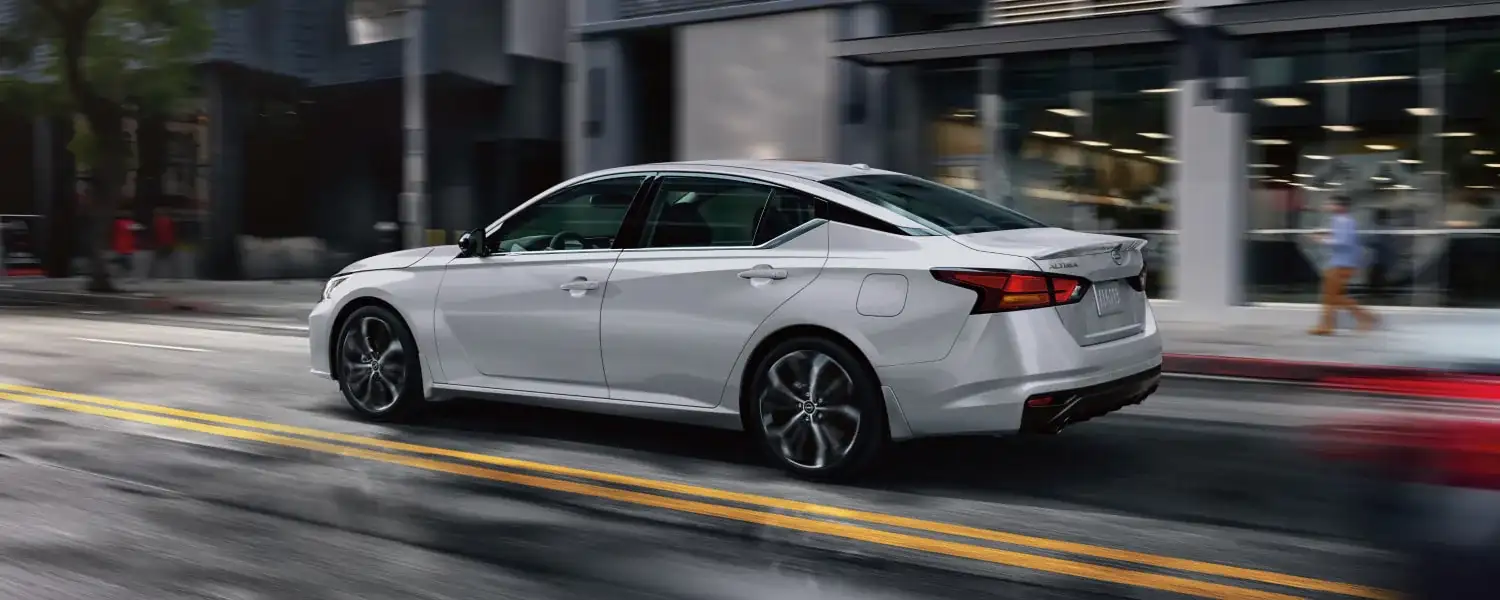
The 2025 sedan landscape is heating up, and two major contenders are the Nissan Altima and the Toyota Camry. For 2025, Toyota has made a significant shift, making the Camry an all-hybrid lineup. Meanwhile, the Nissan Altima continues to offer its reliable and powerful 2.5-liter gas engine. Both sedans are available with either front-wheel drive (FWD) or all-wheel drive (AWD).
This guide will break down the key differences between these two popular models, covering everything from performance and pricing to safety and interior comfort. We’ll help you decide which car is the right fit for your driving needs here in Rhode Island.
Trims and Pricing
When it comes to affordability, the Nissan Altima has a clear edge. Its starting price is lower than the Camry’s, and this price advantage continues across the various trim levels.
2025 Nissan Altima Trims & MSRP:
- S: $27,000 (FWD only)
- SV: $27,430 (FWD) / $28,930 (AWD)
- SV Special Edition: $28,520 (FWD) / $30,020 (AWD)
- SR: $28,830 (FWD) / $30,330 (AWD)
- SL: $33,330 (FWD) / $34,830 (AWD)
2025 Toyota Camry Trims & MSRP:
- LE: $28,700 (FWD) / $30,225 (AWD)
- SE: $31,000 (FWD) / $32,525 (AWD)
- XLE: $33,700 (FWD) / $35,225 (AWD)
- XSE: $34,900 (FWD) / $36,425 (AWD)
Powertrain and Fuel Efficiency
The biggest difference between the two models lies under the hood. Every 2025 Camry is now a hybrid, featuring a 2.5-liter four-cylinder engine paired with an electric motor. This setup produces 225 horsepower with FWD and 232 horsepower with AWD. As expected from a hybrid, the Camry delivers impressive fuel economy, with the FWD LE model achieving up to 51 MPG combined.
Nissan takes a more traditional approach with the Altima, equipping it with a proven 2.5-liter DOHC 16-valve gas engine and a smooth Xtronic CVT. This powertrain delivers 188 horsepower and 180 lb-ft of torque in the FWD configuration. Fuel efficiency is strong for a non-hybrid, with FWD models reaching up to 39 MPG on the highway.
While the Camry’s hybrid system is great for city driving, many drivers prefer the straightforward performance and feel of a conventional gas engine. The Altima offers a more familiar driving experience and excels on the highway, making it a great choice for commuters.
Ride, Handling, and AWD Systems
Both the Altima and Camry offer the confidence of All-Wheel Drive, but their systems operate differently. Toyota’s Electronic On-Demand AWD is reactive, engaging only when it detects wheel slippage.
Nissan’s Intelligent AWD is more proactive. It constantly monitors road conditions, your steering, and how you’re driving to anticipate the need for more traction. It can preemptively send power to the rear wheels before slippage even occurs. This is a huge advantage for navigating Rhode Island’s unpredictable weather, from sudden downpours to snowy winter roads. While Toyota’s system reacts to problems, Nissan’s system helps prevent them from happening in the first place.
Safety and Driver Assistance
Both Nissan and Toyota prioritize safety. The 2025 Altima comes standard with Nissan Safety Shield® 360, a suite of advanced driver-assist features including Automatic Emergency Braking with Pedestrian Detection, Blind Spot Warning, and Rear Cross Traffic Alert. Higher trims also offer ProPILOT Assist, a hands-on system that combines intelligent cruise control and steering assistance to make highway driving easier. The Altima earned a five-star overall safety rating from the NHTSA.
The Camry is equipped with Toyota Safety Sense 3.0, which includes similar features like a pre-collision system and lane departure alert. It was named a 2025 IIHS Top Safety Pick+. Notably, the Altima also includes an Intelligent Driver Alertness monitor, which can detect drowsy driving patterns and suggest taking a break—a valuable feature for long trips.
Cabin, Tech, and Infotainment
Inside, the Altima offers an available 12.3-inch HD color touchscreen with wireless Apple CarPlay® and Android Auto™, plus a wireless charging pad. Base models feature a user-friendly 8-inch screen.
Toyota makes wireless connectivity standard across the Camry line, with an 8-inch screen on the base model and an available 12.3-inch screen on higher trims.
Space, Comfort, and Practicality
If you prioritize front-seat comfort, the Altima is the clear winner. It offers a generous 43.8 inches of front legroom, compared to the Camry’s 42.1 inches. The Altima also features Nissan’s Zero Gravity seats, which are designed to reduce fatigue on long drives. In the back, the Camry provides slightly more legroom.
For cargo, the Altima has a slight edge with 15.4 cubic feet of trunk space, while the Camry offers 15.1 cubic feet.
Find Your Perfect Match at Speedcraft Nissan
While the Toyota Camry has its merits, the 2025 Nissan Altima stands out with its more affordable pricing, comfortable front seating, proven gas engine, and proactive Intelligent AWD system. It offers a compelling package for drivers in Rhode Island who value comfort, safety, and all-weather capability.
Ready to see for yourself? Visit us at Speedcraft Nissan in West Warwick, RI, to test drive the 2025 Altima. Our team is ready to show you all the available options, discuss trade-in values, and help you find the perfect car for your needs.
0 comment(s) so far on 2025 Nissan Altima vs. 2025 Toyota Camry